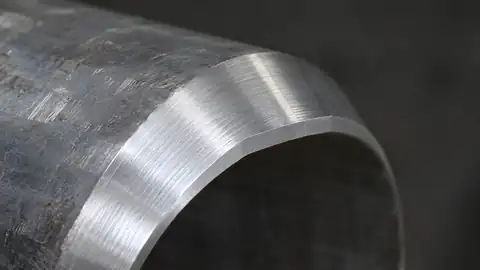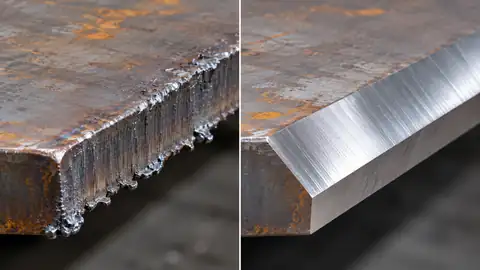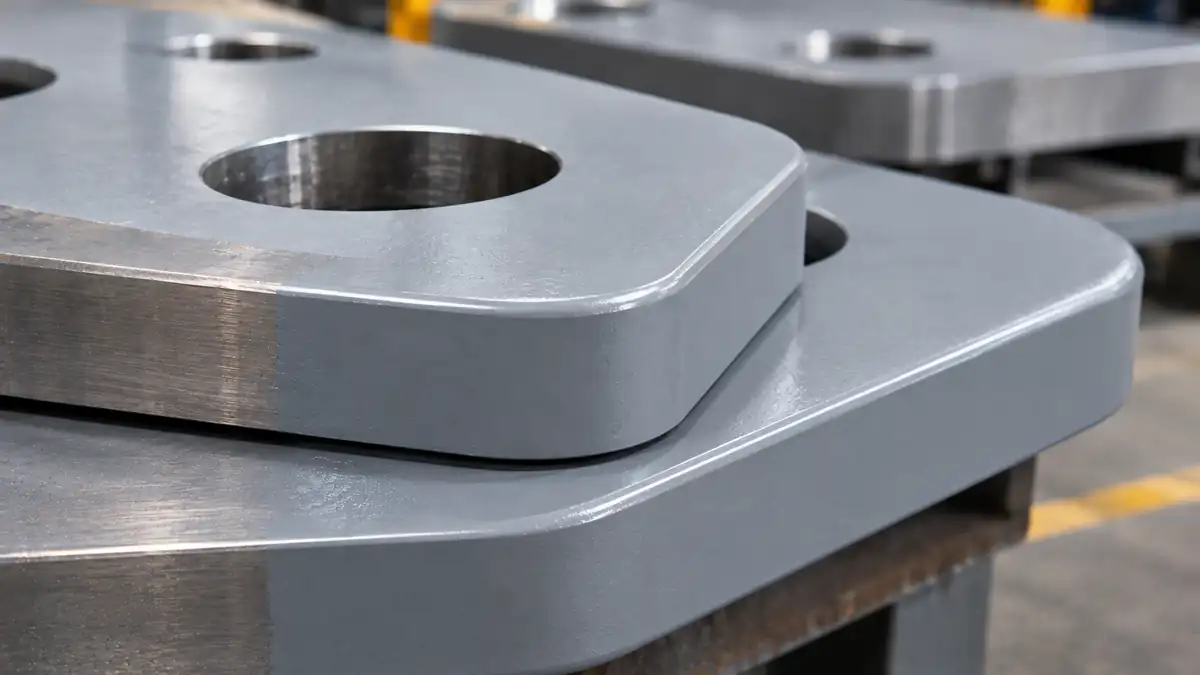
Sharp edges should be rounded to a radius of at least 2 mm before painting — this is the requirement for preparation grade P3 in ISO 8501-3, and the same 2 mm radius appears in coating standards and specifications for ships, bridges and offshore structures. A rounded edge lets the paint film keep its thickness instead of pulling thin over the corner.
Why coatings fail on edges
As wet paint cures, surface tension pulls it away from a sharp corner. The dry film on the arris can end up at a fraction of the specified thickness, so corrosion starts there first. Cut edges also carry hardened material and micro-burrs that resist blast cleaning.
What the standards ask for
- ISO 8501-3 grades the preparation of welds, edges and other imperfections from P1 (light) to P3 (very thorough). P3 requires edges to be rounded with a radius of not less than 2 mm.
- ISO 12944-3 (design for corrosion protection) recommends rounding edges so that the coating can be applied uniformly.
- Offshore and marine owners' specifications typically repeat the 2 mm minimum radius.
Grinding vs machine rounding
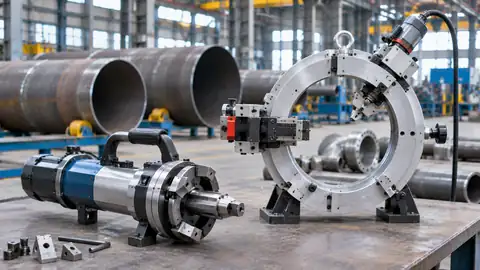
Hand grinding with a flap disc can achieve a radius, but it varies with the operator and gets slower as the edge length grows. An edge rounding machine mills a defined R2 or R3 profile with a form cutter, so every metre of edge has the same radius. Double-head machines round the top and bottom edges in the same pass.
Where it fits in the workflow
- Thermal cutting of parts.
- Slag and burr removal on both faces.
- Edge rounding to R2 or R3.
- Abrasive blast cleaning.
- Coating.
Frequently asked questions
What edge radius is needed before painting?
At least 2 mm for ISO 8501-3 grade P3, which is the usual requirement for high-durability coating systems.
Is chamfering the same as rounding?
No. A chamfer leaves two new corners; most coating specifications ask for a radius, which machines with R2/R3 form cutters produce.
Should edges be rounded before or after blasting?
Before blasting, so the blast profile covers the rounded edge.