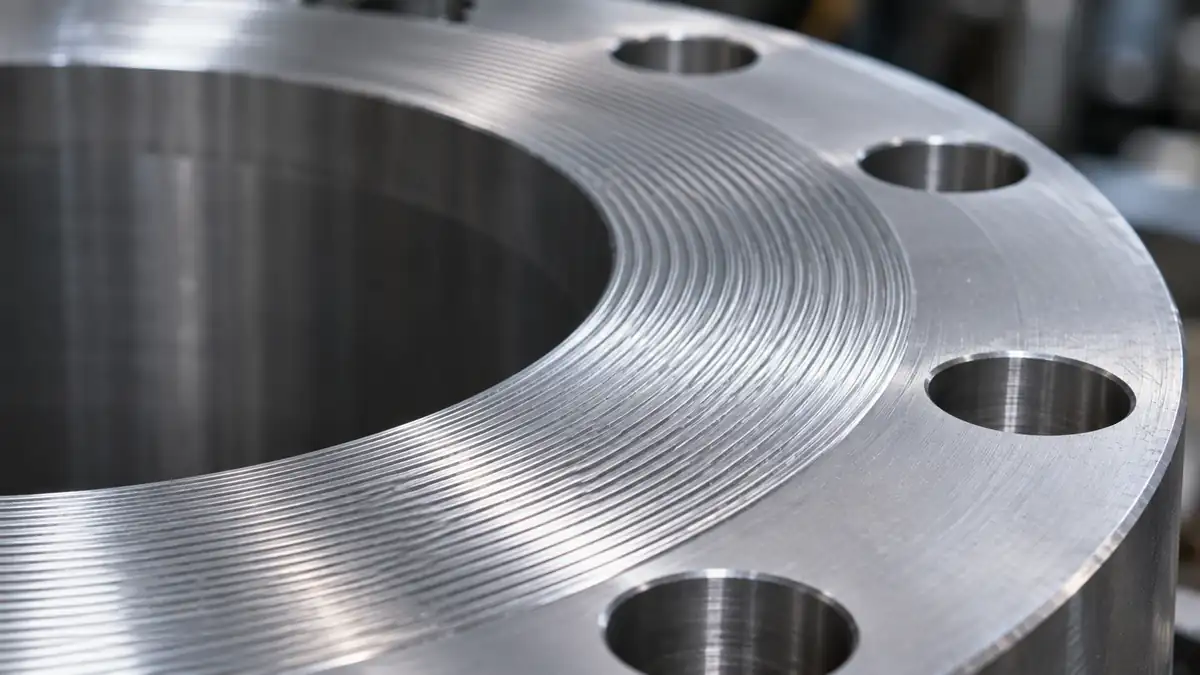
For raised-face flanges, ASME B16.5 specifies a serrated finish with a roughness of 3.2–6.3 µm Ra (125–250 µin), produced as concentric or spiral grooves. Ring-type joint (RTJ) grooves need a much smoother finish on the groove side walls, 1.6 µm Ra (63 µin) maximum. Other finishes can be agreed between purchaser and manufacturer, and gasket makers publish their own recommendations.
Why serrations?
A soft or semi-metallic gasket seals by flowing into the face under bolt load. Serrations give it something to bite into and break up any leak path that would otherwise run straight across a smooth face. That is why a face that looks "too smooth" after hand polishing can seal worse than a correctly serrated one.
RTJ grooves
Ring-type joints seal metal to metal: the oval or octagonal ring deforms against the groove walls. Any scratch across the groove wall is a leak path, so these grooves are machined to a fine finish and checked carefully for damage.
Common face damage
- Radial scratches from gasket removal tools.
- Pitting and corrosion under old gaskets.
- Steam or product cutting where a joint has leaked.
- Distortion after welding the flange to the pipe.
Restoring faces on site
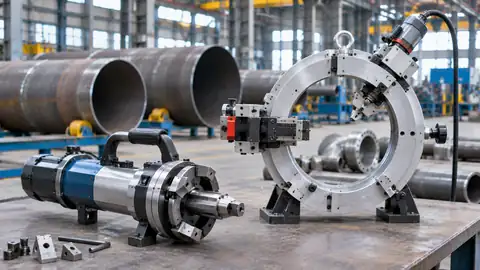
A portable flange facer clamps in the bore (ID-mounted) or around the outside (OD-mounted) and turns a single-point tool across the face. The feed per revolution sets the serration pitch, so the same machine can cut a spiral serrated finish for spiral-wound gaskets or a fine finish for metal gaskets. Remove only as much material as needed to reach clean metal, and check the remaining raised-face height against the flange standard.
| Face type | Typical requirement |
|---|---|
| Raised face, serrated | 3.2–6.3 µm Ra, concentric or spiral |
| RTJ groove side walls | ≤1.6 µm Ra |
| Other finishes | By agreement and gasket maker guidance |
Frequently asked questions
What is the surface finish for an ASME B16.5 raised-face flange?
A serrated concentric or spiral finish of 3.2–6.3 µm Ra (125–250 µin).
What finish does an RTJ groove need?
The groove side walls should not exceed 1.6 µm Ra (63 µin).
Can a damaged flange face be repaired without removing the flange?
Yes. A portable flange facing machine mounted on the flange re-machines the face in place.